

Context Aware IDP: The Next Generation of Intelligent Document Processing
As enterprises increasingly rely on document automation, the limitations of traditional IDP solutions are becoming more apparent. While OCR, rule-based extraction and incumbent IDP have served as foundational technologies, modern Intelligent Document...
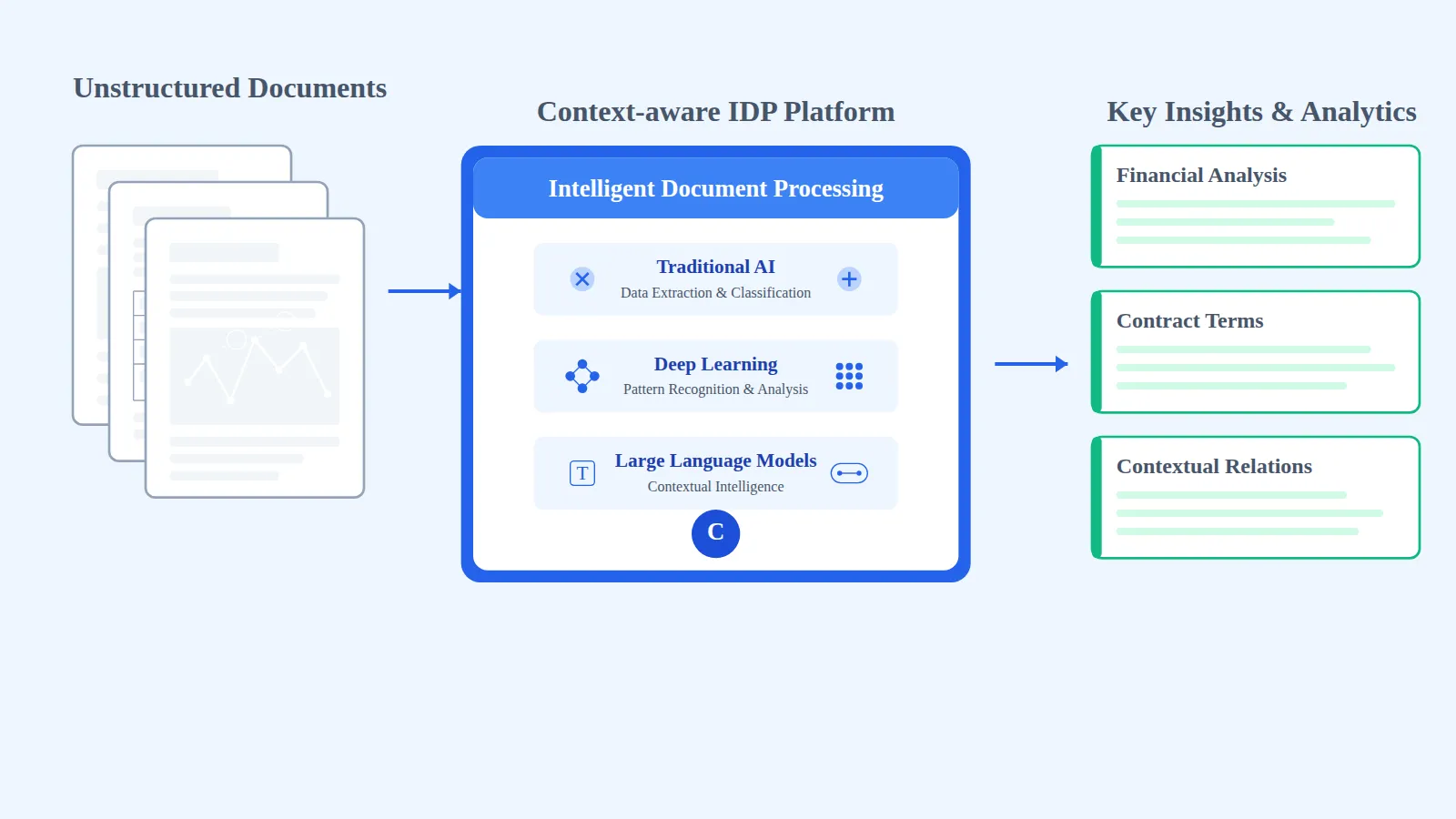
As enterprises increasingly rely on document automation, the limitations of traditional IDP solutions are becoming more apparent. While OCR, rule-based extraction and incumbent IDP have served as foundational technologies, modern Intelligent Document Processing (IDP) must go far beyond simple text recognition. The future of IDP lies in bringing an intelligent mix of traditional AI and Gen AI/LLM to offer context-aware processing by applying intelligent chunking, adaptive layout analysis, and domain-specific knowledge to truly automate document-heavy workflows.
Moving Beyond Text Extraction
Traditional document automation often struggles with complex layouts, tabular data, unstructured data, and document variations across industries. The next generation of IDP solutions must incorporate:
Context Awareness
AI models that not only extract text but also understand its meaning within a business process.
Lean Learning
Ability to learn with minimal training samples and achieve high accuracy.
Intelligent Chunking
The ability to break down large, unstructured documents into meaningful, structured components.
Advanced Layout Analysis
Understanding of document structure and preserving the underlying information hierarchy for further context analysis.
Domain-Specific Adaptability
Applying industry-specific entities (Drug name) and Named entities (Person name) to enhance extraction accuracy.
Key Capabilities for Effective IDP
Offer high accuracy with minimal training
Most traditional AI models require large amount of training samples to saturate the learning which leads to high training cost, longer training period and uncertainty of going live with trained model. IDP with lean learning capability can offer better business case justification and will reduce the friction in adoption.
Document Indexing and Chunking for LLM/RAG Optimization
Large Language Models (LLMs) and Retrieval-Augmented Generation (RAG) approaches require structured inputs (self-complete chunks) to generate meaningful outputs. An effective IDP system should pre-process documents to improve comprehension and retrieval accuracy.
Form Processing with Layout Variability
Many industries rely on forms with checkboxes, multi-template formats, and noisy document conditions (e.g., skewed, grayscale, low-quality scans). A robust IDP system must classify and extract key data accurately, regardless of form variations.
Automated tabular data extraction across document types
Financial documents, invoices, and reports contain complex table structures with merged cells, multi-page spans, and varying formats. IDP should extract structured table data without requiring continuous model retraining.
Flexible Deployment: SaaS and On-Prem Solutions
Enterprises require IDP solutions that align with their security and infrastructure needs. A scalable IDP platform should be available both as an API service and an on-premises deployment for regulated industries.
The Future of Intelligent Document Processing
The evolution of IDP is not just about better accuracy—it's about true measurability of automation and minimal human intervention. Modern IDP systems must be designed to integrate seamlessly with enterprise workflows, enabling straight-through processing rather than requiring manual review.
With AI advancements driving document understanding, the next wave of IDP solutions will bridge the gap between unstructured content and actionable insights, allowing businesses to unlock the full potential of their data.
The future is here—where IDP is no longer just about extracting information but about truly understanding and processing documents like a human would.
Intelligent Document Processing (IDP) is evolving beyond traditional OCR and rule-based automation. The real challenge lies in handling unstructured data with context awareness, intelligent chunking, and layout adaptability while ensuring high accuracy across diverse document types. The most sought-after capabilities today include domain-aware AI, robust table and form extraction, and seamless integration with LLMs for deeper document understanding.